The Theresan Military Academy is the oldest Military Academy of the world, founded in 1752 with a simple order issued by Empress Maria Theresa: “make out of them fine officers and righteous men”.

The Theresan Military Academy is the oldest Military Academy of the world, founded in 1752 with a simple order issued by Empress Maria Theresa: “make out of them fine officers and righteous men”.
The basic education and training of the officers of the Austrian armed forces, including the air component, is also nowadays the role of the Theresan Military Academy. The Institute for Basic Officer Education at the Military Academy, for candidates of both direct and internal recruitments, is recognised as fully integrated in the European Higher Education Area and, like any other Austrian university, provides a higher education curriculum. In order to be commissioned as officers, the Austrian cadets must obtain the Bachelor of Arts in Military Leadership from the Academy, after three years of academic studies, which include a training period, similar to a stage, in units of foreign armed forces. An additional Bachelor study programme in the field of information and communication technology will start in 2022.
The academic aspect of the basic education of an Austrian officer, therefore, is necessarily the product of an international cooperation or, in some cases, of the cooperation between the Academy and civilian universities. Every cadet spends one international semester abroad as well as an internship (International Training on the Job) in the course of his/her education.
The vocational training also is the product of cooperation between the Military Academy and the operational units of the armed forces themselves, since the national conscript service contributes also to the acquisition of basic military skills.
Since Austria has no Air Force Academy, all candidates foreseen for the air component have to undergo the education at the Theresan Military Academy. Because of long lasting education for e.g. pilots, they have to undergo the training before they begin their studies at the Military Academy. This education is done at the Air & Air Defence School of the Austrian Armed Forces.
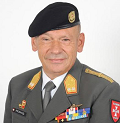
Educational and Professional Background:
International Experience:
Special Qualifications:
Marital Status:
Hobbies:
The Theresan Military consists of the following institutes and departments:
Address
Phone numbers,Fax, Email
Web Page
In 1993 the European Air Chiefs Conference (EURAC) was established with the main objective finding new methods of study and co-operation among European Air Forces – within and out of NATO. In this context a considerable importance has been given for a common vision in the ways of education and formation of future officers
Consequently the European Air Force Academies (EUAFA) Commanders’ Conference has been established as a forum of experts in order to exchange information, co-operate and identify areas of common interest to carry out activities, with the largest possible participation of all the member nations, in the field of officer education and training.
EUAFA mission is to encourage mutual education through the sharing of information on officer training by promoting academic and military exchanges concerning cadet and instructor training.
The (EUAFA) Commandants’ Conference comprises of the Commandants of the Air Force Academies of the following European countries:
AUSTRIA, BELGIUM, CZECH REPUBLIK, DENMARK, FINLAND, FRANCE, GERMANY, GREECE, HUNGARY, IRELAND, ITALY, NETHERLANDS, NORWAY, POLAND, PORTUGAL, ROMANIA, SPAIN, SWEDEN, SWITZERLAND, TURKEY, UNITED KINGDOM.
The members of the conference annually elect a Chairman, who is responsible for the preparation of the meetings and who acts as Point of Contact (POC) for all members.
The Chairman, who is appointed for one year for the period between two Commandants’ Conferences, is the Commandant (or his representative) of the Academy that is designated to host the conference at the end of his term.
In order to find common elements within the syllabi of the EUAFAs a Working Group was established in 1998. The ultimate goal was to identify portions of the individual training and education programs that might be suitable for common training and/or mutual exchanges
The EUAFA Working Group is responsible for the following tasks: view the member nations syllabi and focus on common fields within which to provide a basis for future co-operation in training and cadet exchanges; gather, update and disseminate the Databank (available at the website, and updated by the appropriate Working Group member) containing:
In order to achieve a better understanding regarding main areas of training in each country’s officer training syllabus and from which common areas of interest could be found: